 HELP CENTRE


Business Cards
Foil Business Cards: The Complete Guide to Gold and Silver Foil
Sep
There is a reason the most expensive object in almost any room, the award, the invitation, the box of chocolates someone is saving, tends to be the one with gold or silver foil on it. Foil does something no printed colour can do: it catches the light and moves with it. Tilt a foil stamped card and the lettering flares, dims and flares again, like jewellery.
This guide covers what hot foil stamping actually is, where the technique came from, the famous designs you already know it from, and how to design a business card that uses it well.
Want to see which papers take foil best? Read our Business Card Paper Guide.
What Is Hot Foil Stamping?
Hot foil stamping is one of the oldest finishing techniques still in commercial use, and mechanically it has barely changed: a metal die carrying your design is heated to around 100 to 180 degrees, then pressed through a foil ribbon onto the card. Where the raised die meets the sheet, heat and pressure bond the foil to the stock. Everywhere else, the ribbon peels away clean.
The “foil” itself is cleverer than it looks. It is not a loose sheet of metal but a multi-layer ribbon: a polyester carrier, a release layer, a lacquer layer, a genuinely metallic layer of vacuum-metallised aluminium, and a heat-activated adhesive underneath. The press transfers everything below the carrier onto your card in a fraction of a second.
The whole process is dry. No ink, no solvents, no drying time. Just heat, pressure and metal.
Why Foil Outshines Metallic Ink
You can buy “gold” ink, and there are times it is the right tool. But metallic ink is metal flakes suspended in a printing medium, and it behaves like ink: semi-translucent, slightly dull, and prone to sinking into the sheet.
Foil is an actual layer of metal sitting on top of the card. That gives it three properties ink cannot match:
- It is completely opaque. Gold foil on a black card is still pure, bright gold. No show-through, no muddying, which is why foil owns the dark-stock look.
- It is mirror-reflective. Foil reacts to the angle of light the way real metal does. Ink shimmer is flat by comparison.
- It is pressed in. The die leaves a subtle impression you can feel, and our foil cards go a step further with a raised foil finish, so the lettering sits proud of the surface under your thumb.
A Short History, From Gold Leaf to the Golden Ticket
Foil stamping is the industrial descendant of hand gilding. Bookbinders were laying real gold leaf onto leather covers centuries before industrial printing existed, and by the reign of Henry VIII the royal binder Thomas Berthelet was gold-tooling books for the English court. Real gold, applied by hand, one book at a time.
The modern process arrived in 1892, when the Berlin bookbinder Ernst Oeser patented hot stamping with manufactured foils, developed because genuine gold leaf had become too expensive for mass book production. The technique that once decorated bibles for royalty became something any well-made object could wear, and design has been using it as shorthand for quality ever since.
Foil Designs You Already Know
Once you start looking, gold and silver foil marks an extraordinary number of the objects our culture treats as special. It is worth pausing on a few of them, because each one is a small lesson in why the technique works.
On the bookshelf
Penguin’s Clothbound Classics are probably the most recognisable modern foil design in the world. Coralie Bickford-Smith’s covers stamp a single repeating motif drawn from each story, keys, waves, flowers, into cloth, never using more than two foil colours per cover. The series is widely credited with reviving the collectible hardback in the eBook era, and its restraint is the masterclass: one motif, one or two foils, nothing else.
The same shelf holds two more. The gold seal on an award-winning children’s book, the Newbery and Caldecott medals, is a literal gold foil sticker that publishers must buy from the American Library Association, and “the one with the gold sticker” has become shorthand for quality worldwide. And at the very top of the pile, every Nobel Prize diploma is hand-lettered, bound in leather and stamped in gold, with gold leaf part of the official design since 1925.
In the chocolate aisle
Ferrero Rocher is essentially gold foil as a brand. Each chocolate has been individually wrapped in gold since 1982, an experience its creator called “the golden experience”. The Lindt Gold Bunny has worn its gold wrap since 1952, around 150 million of them a year, and Lindt has fought trademark battles over the gold foil wrap itself. When lawyers argue over who owns a shade of gold wrapping, the signal value of the material is settled.
On screen
The screen-used Golden Tickets from the 1971 Willy Wonka film were foil-printed props with hand-cut edges, and surviving tickets now sell at auction for five figures. The Oscars winners’ envelope of the 2010s carried an Art Deco frame in satin gold foil with the statuette hand-stamped in gold leaf inside, roughly ten finishing processes for an envelope that spends thirty seconds on camera. And the business card scene in American Psycho, cinema’s most famous four minutes about print, is an argument about raised lettering, stock and subtle colour. The cards in that scene aren’t foil, but the obsession is the point: people notice what a card is made of.
In your pocket
The gold crest on the cover of an Australian passport carries the same tradition: a gold-embossed mark of authenticity, descended from the wax and gold seals once used to make documents official. And if you want the living link between hand gilding and modern print, Smythson of Bond Street still stamps initials in gold using hand-set brass type heated over gold foil, the same method for more than 120 years.
None of these objects would read the same in yellow ink. That is the entire case for foil.
Gold or Silver?
Both metals signal quality. They just say it in different accents.
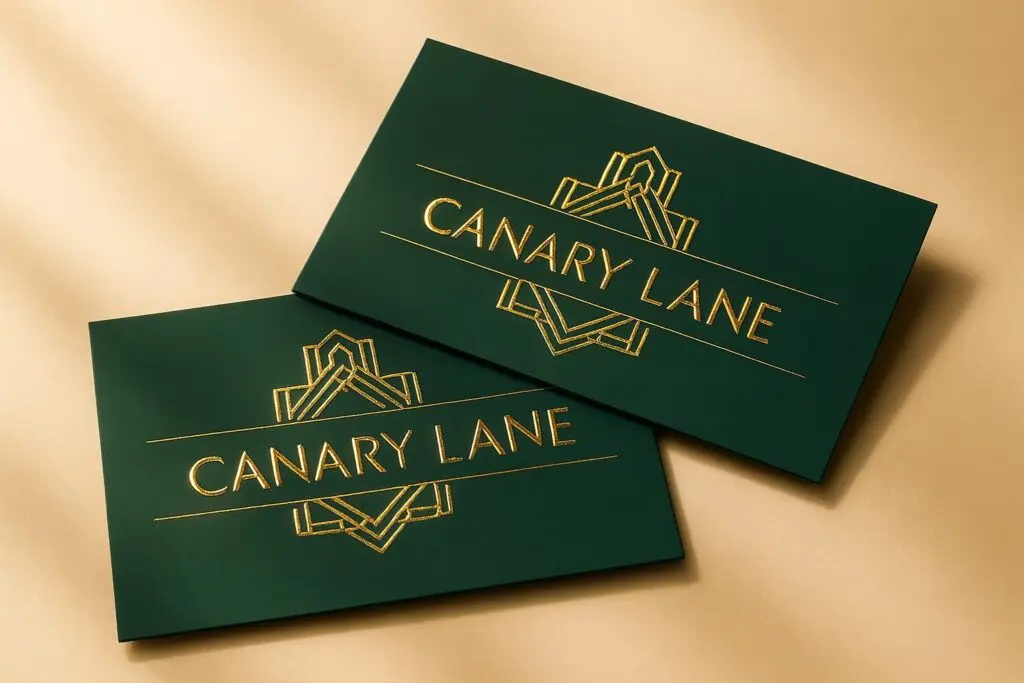
Gold is warm, traditional luxury. It reads as heritage, craftsmanship and occasion, which is why it dominates wedding stationery, wine labels, law firms and premium hospitality. It is at its most dramatic on dark stock: deep green, navy or black card with gold foil is the classic luxury pairing, and it needs no other decoration.
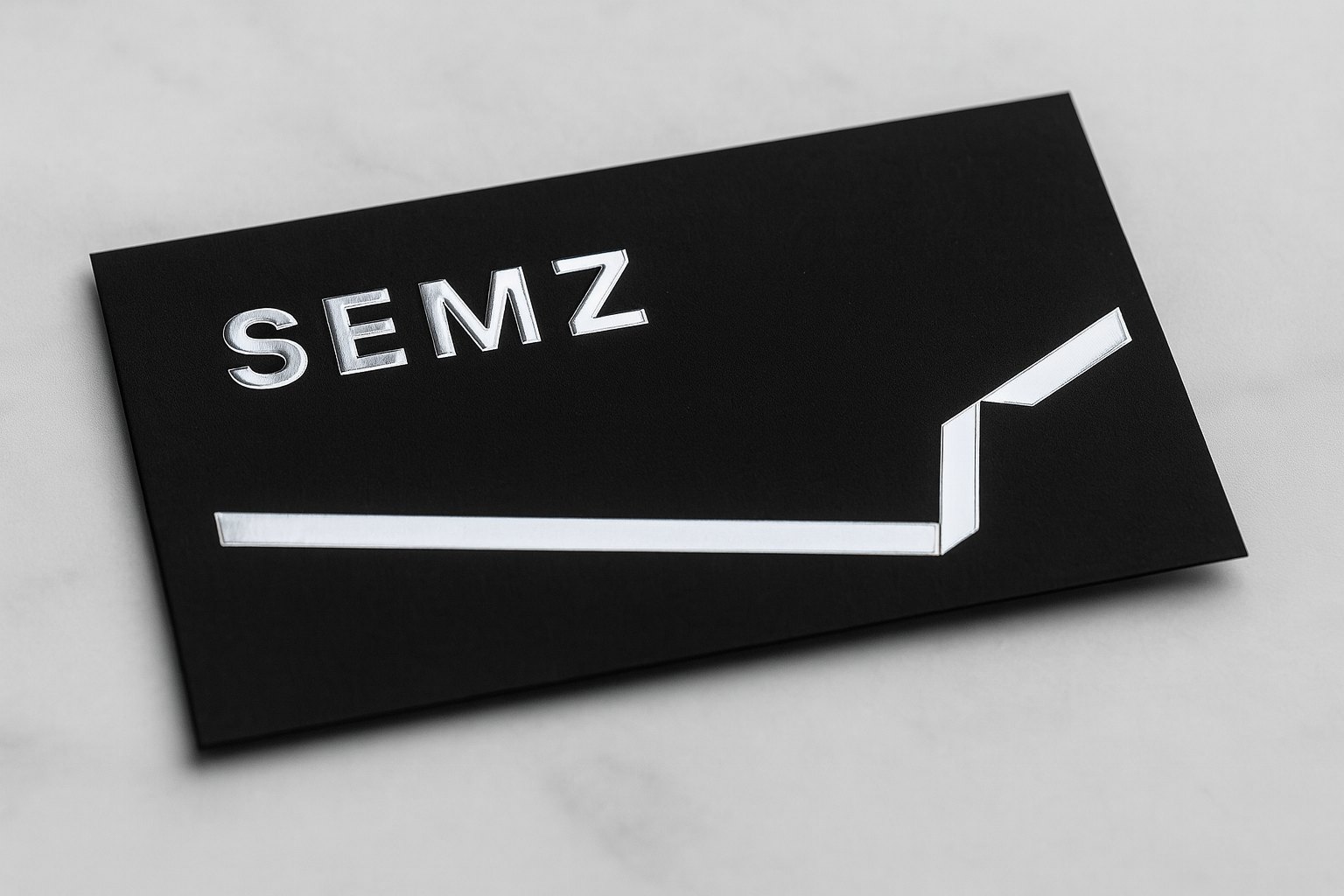
Silver is cool, precise and modern. It pairs beautifully with black, white, grey and cooler brand palettes, and suits architects, tech, finance, medical and any brand built on clean lines. On a matte black card, silver foil reads sharp and engineered rather than ornate.
They are not the only options. We also print Rose Gold Foil Business Cards for warmer, softer branding, and a specialty hot foil range in copper, electric blue, red and magenta for brands that want the foil effect outside the classic metals.
Designing Artwork That Foils Well
Foil is a physical process, metal pressed into card, and the best foil designs respect that. A few rules make the difference between crisp and clogged:
- No hairlines. Keep line weights to at least half a point. Ultra-fine lines and delicate serifs can fill in when the die strikes.
- Keep type 8pt or larger. And give it room: foil stamping makes type appear slightly bolder, so loosen spacing rather than tightening it.
- Avoid huge solid areas. Foil is at its best in lettering, logos, borders and accents. Very large foil floods risk imperfections and rarely look better than a confident accent.
- Design for contrast. Gold on dark stock, silver on black or white. The card colour is doing half the work.
- Let foil be the hero. One element in foil, given space, beats five elements fighting for shine. The restraint is what reads as expensive.
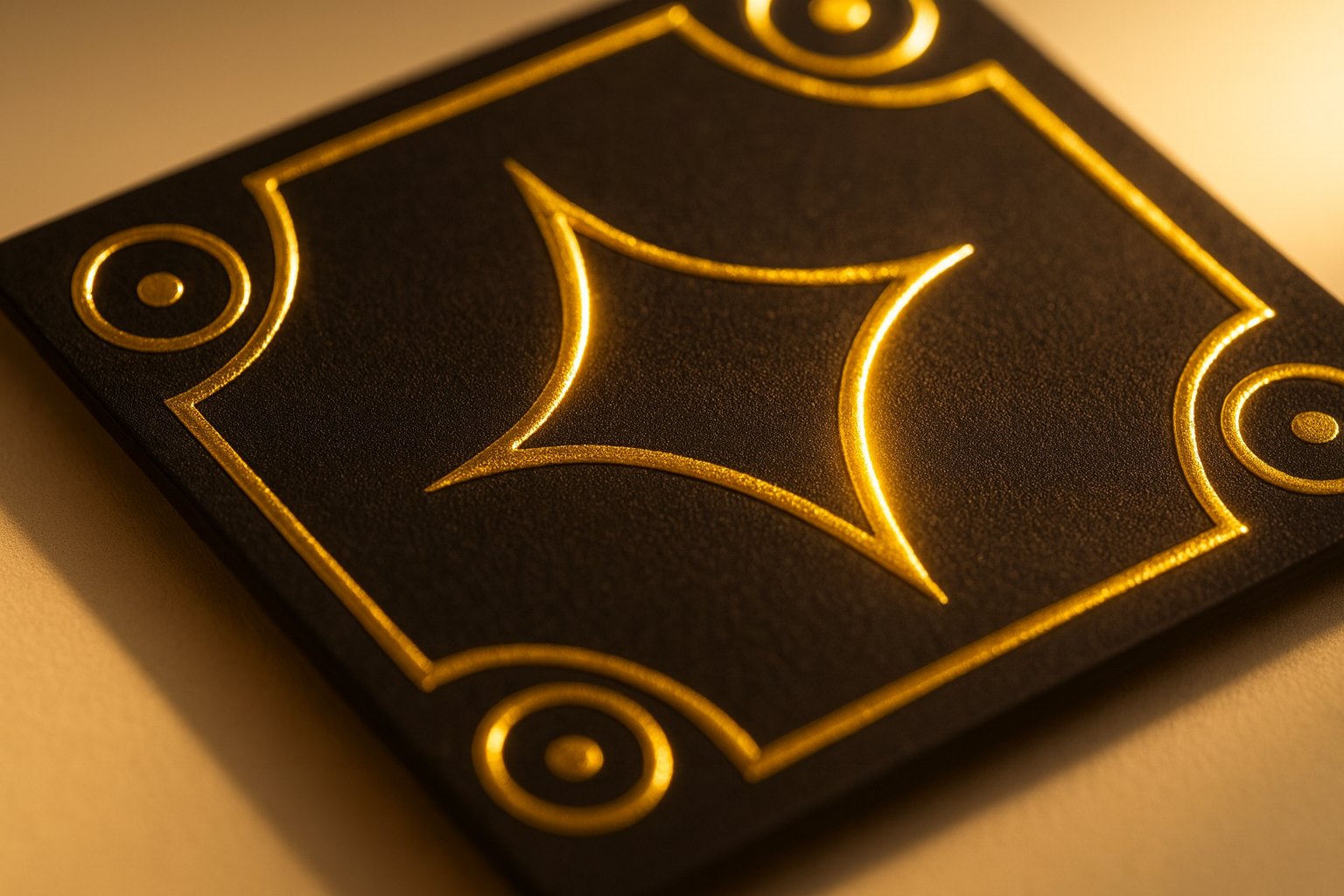
Why You Cannot Judge Foil on a Screen
Here is the strange thing about ordering foil: no screen can show it to you. A screen emits light; foil reflects it. The entire effect, the flare and shift as the card moves, is physically impossible to reproduce in a static mockup, which is why foil areas on a digital proof appear as a flat placeholder colour showing exactly where the foil will sit.
So when you order, judge placement and artwork on the proof, and trust the physics for the rest. The real card is always more impressive than the preview. It is one of the few products where what arrives beats what you saw on screen.
Foil, Spot UV or Scodix?
Foil is one of three ways we make an element of your card catch the light, and choosing between them is easier than it looks:
| Finish | What catches the light | The effect in hand |
|---|---|---|
| Foil | Actual metal, pressed in | Mirror-bright and metallic. The only one that reads as gold or silver. |
| Spot UV | Glossy clear coating on chosen elements | A wet-look shine in the colour printed beneath it. Subtle until the light hits. |
| Scodix | Raised clear gloss, built up thick | The logo physically stands up off the card, glossy and tactile, but not metallic. |
The rule of thumb: if the element should look like metal, it has to be foil. If it should shine in its own printed colour, Spot UV. If height and touch matter more than metal, Scodix. All three sit on the same premium 450GSM velvet stock, so the base card feels identical.
Our Foil Business Card Range
| Range | Foil | Stock | Best suited to |
|---|---|---|---|
| Gold Foil | Raised gold foil, one side | 450GSM velvet | Classic luxury, dark designs, heritage brands |
| Silver Foil | Raised silver foil, one side | 450GSM velvet | Modern, minimal, cooler palettes |
| Rose Gold Foil | Rose gold foil, one side | 450GSM velvet | Beauty, events, warm softer branding |
| Specialty Hot Foil | Copper, electric blue, red or magenta | 420GSM matt | Brands that want foil outside the classic metals |
Every card is printed in full colour offset on one or both sides, with the foil applied on one side. There are no foil setup fees, and the raised foil finish sits on the same soft-touch velvet stock as our velvet range, so the card feels as considered as it looks.
If you want the foil look beyond cards, our Silver Foil Labels bring the same finish to product labelling in circles, squares, rectangles and custom shapes.
How Much Do Foil Business Cards Cost?
Current pricing on our website starts at:
| Quantity | Gold or Silver Foil, from |
|---|---|
| 250 cards | $207 |
| 500 cards | $264 |
| 1,000 cards | $366 |
| 2,000 cards | $554 |
All prices exclude GST and include free standard delivery Australia wide. Custom foil work traditionally starts with paying for a die to be made before a single card is pressed; we charge no foil setup fees at any quantity.
Frequently Asked Questions
Is the foil actually raised?
Yes. Our gold and silver foil cards use a raised foil finish, so the foiled elements sit proud of the card surface. You see the shine and feel the lettering.
Can I have foil on both sides?
The foil is applied to one side. The printing itself can be single or double sided in full colour, so the reverse of the card carries your details in print while the front carries the foil.
Does foil work on light-coloured cards?
Beautifully. Gold foil on cream or white stock is a softer, more understated luxury than gold on black, and silver on white reads crisp and contemporary. The foil stays fully metallic on any base colour because it is opaque metal, not ink.
Will small text work in foil?
Keep foiled type to 8pt or larger and avoid ultra-thin fonts. Anything borderline gets flagged when we review your artwork, and you approve a proof before anything is pressed.
How long does it take?
Allow 5 to 7 business days in production before dispatch, slightly longer than standard cards because foiling is an extra press pass. Delivery from there depends on the courier, so delivery times can’t be guaranteed.
Can I get foil on labels or other products?
Yes. Our Silver Foil Labels range covers circles, squares, rectangles and custom shapes, ideal for product packaging that wants the same catch-the-light finish.
Ready to Order?
You can order Gold Foil or Silver Foil Business Cards online in a few minutes: choose your quantity, upload your artwork, and we’ll send you a digital proof showing exactly where the foil will sit before printing.
Not sure whether gold, silver or one of the specialty foils suits your design? Email us at [email protected] or get in touch through the contact page and we’ll give you a straight answer.