
Guides
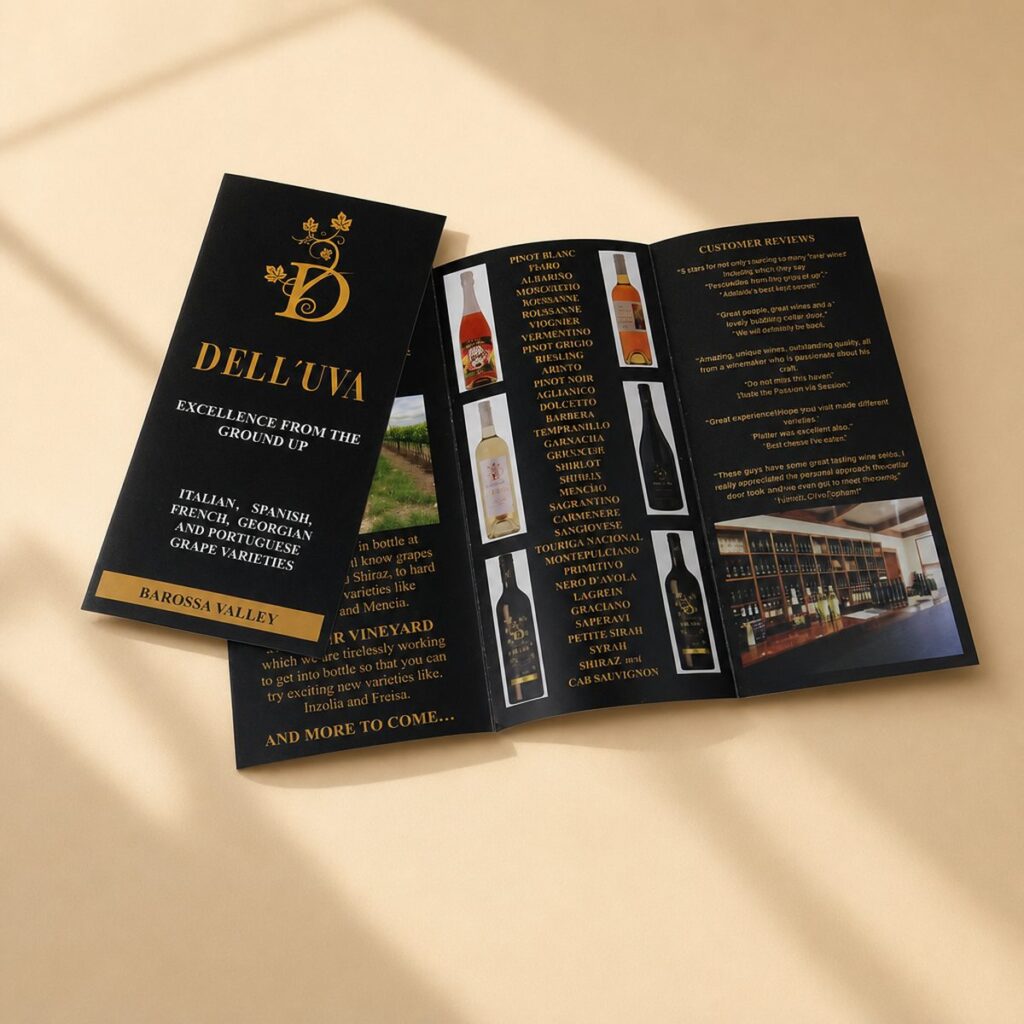
Brochure Sizes and Folds: Tri Fold, Half Fold and DL Explained
Nov
Quick answer: Most printed brochures in Australia are one of two kinds. A tri fold is an A4 sheet (297 x 210mm) folded twice into a DL brochure of about 99 x 210mm, with six panels. A half fold is a sheet folded once into four pages: A4 folds to A5 (148 x 210mm), A5 folds to A6 (105 x 148mm) and A3 folds to A4 (210 x 297mm). Set your file up at the flat size, add 3mm bleed and keep text at least 5mm away from every fold.
This guide covers brochure sizes in millimetres and inches, the main folds and when to use each, tri fold panel widths, paper stocks, how to set up the file, and what brochures cost to print.
Brochure sizes chart
| Brochure | Flat sheet | Folded size | Folded size in inches | Panels or pages | File size with 3mm bleed |
|---|---|---|---|---|---|
| DL tri fold (roll fold or Z fold) | A4, 297 x 210mm | about 99 x 210mm (DL) | 3.90 x 8.27 in | 6 panels | 303 x 216mm |
| A6 half fold (A5 folded to A6) | A5, 210 x 148mm | 105 x 148mm | 4.13 x 5.83 in | 4 pages | 216 x 154mm |
| A5 half fold (A4 folded to A5) | A4, 297 x 210mm | 148 x 210mm | 5.83 x 8.27 in | 4 pages | 303 x 216mm |
| A4 half fold (A3 folded to A4) | A3, 420 x 297mm | 210 x 297mm | 8.27 x 11.69 in | 4 pages | 426 x 303mm |
Flat sizes are given landscape (the way the sheet is printed); folded sizes are width x height in portrait. These are the sizes on our tri fold brochures and half fold brochures pages. For the full A size chart, see our A paper sizes guide.
What size is a DL brochure?
A DL brochure is about 99 x 210mm (3.90 x 8.27 inches) when folded. It is one third of an A4 sheet, which is why an A4 sheet folded twice makes one. DL is the size that slides into a standard DL envelope (110 x 220mm), a brochure rack or a letterbox. For DL flyers, envelopes and with compliments slips, see DL sizes compared.
Brochure folds explained
Roll fold (the classic tri fold)
The right panel folds in first, then the left panel folds over it. The panels nest inside each other, so the reader opens it like a book, one panel at a time. It suits content told in steps: a price list, a service menu, a story with a start and an end. This is the brochure most people picture.
Z fold
The sheet folds into a zig zag, so all three panels open flat in one pull. It suits maps, timetables, timelines and anything designed as one wide picture. It is made from the same A4 sheet as a roll fold and, with us, costs the same.
Half fold (also called bi-fold)
One sheet folded once down the middle gives four pages: a front cover, two inside pages and a back. It reads like a small booklet and gives you bigger pages than a tri fold, so it suits menus, event programs, orders of service and anything with photography.
Gate fold and other folds
In a gate fold, the two outer panels fold in to meet in the middle, like doors. Gate folds, A3 tri folds and custom sizes are not on our product pages, but you can ask for a price through the Custom Quote tab on the tri fold brochures page. For 8 pages or more, see our booklets.
Which brochure should you choose?
| If your brochure is… | Choose | Why |
|---|---|---|
| A price list, service menu or step by step story | DL tri fold, roll fold | Six panels read in a set order and it fits racks, counters and DL envelopes |
| A map, timetable or timeline | DL tri fold, Z fold | Opens flat in one pull, all three inside panels show at once |
| A cafe menu or wine list | A4 folded to A5 | A cover out front and the full list inside, on bigger pages |
| An event program or order of service | A5 folded to A6 | Fits in one hand or a pocket |
| A company or product brochure, capability statement | A3 folded to A4 | Four full A4 pages, room for real content and photos |
| 8 pages or more | Booklet | More pages than a fold can hold |
Tri fold brochure panel widths
On a roll fold, the panel that folds inside has to be slightly narrower than the others, or it jams when the brochure is folded. Split the 297mm A4 width like this:
- Roll fold: 98mm, 99mm and 100mm, with the narrow 98mm panel being the one that folds inside. We also accept 99/99/99mm or 97/100/100mm. Any other split is sent back for correction before printing.
- Z fold: three equal panels of 99mm.
Panel order catches people out. Your file has two pages: page 1 is the outside, page 2 is the inside. On a roll fold, the outside page reads from left to right as inside flap, back cover, front cover. The front cover is on the right, not the left.
On a half fold, the outside page has the back cover on the left and the front cover on the right, and page 2 is the inside spread. The fold runs down the exact centre of the sheet.
Brochure paper: which stock and gsm?
Gsm is the weight of the paper in grams per square metre. The higher the number, the thicker and stiffer the sheet. These are the stocks we print brochures on:
| Stock | Feel | Best for |
|---|---|---|
| Gloss 150gsm | The standard brochure paper, bright colour | Most brochures, the lowest price |
| Gloss 170gsm | A little heavier in the hand | When the brochure has to feel more substantial |
| Matt 170gsm | Same weight, soft non reflective finish | Reading under bright lights, a more premium look |
| Gloss 250gsm card (half fold only) | Stiff, stands up in a menu holder | Menus and pieces handled every day |
| Uncoated 100gsm | Light, natural, you can write on it | Order forms and reply panels; colours print softer than on gloss |
Heavy solid ink across the fold of a 250gsm card can show slight wear at the crease. If your design runs dark solid colour over the fold on that stock, we flag it at proof stage.
How to set up a brochure file for printing
- Build the file at the flat size (for example 297 x 210mm landscape for an A4 tri fold), as a two page PDF: outside and inside.
- Add 3mm bleed on every side, so an A4 sheet becomes 303 x 216mm. See what is bleed in printing.
- Keep text and logos at least 5mm inside the trim and at least 5mm clear of each fold line. Let background colour and images run straight across the folds.
- Use images at 300 dpi at the printed size and set the file up in CMYK. We convert RGB files, which can shift colour; see CMYK vs RGB.
- Export a print-ready PDF. Our artwork guidelines cover fonts, rich black and colour.
Free half fold templates (A5 to A6, A4 to A5 and A3 to A4) are on our free templates page, with the trim line and safe zone on a separate layer.
Brochure design tips
- Make the front panel work on its own. In a rack or on a counter it is the only part anyone sees before deciding to pick it up.
- One message per panel. Six small panels read best with a short heading and a few lines each.
- Run a picture across the inside spread of a half fold to make a small brochure feel bigger.
- QR codes: at least 25mm square, and test the printed proof with a phone before you approve it.
- Pick the paper for the photos. Gloss makes product photography pop. Uncoated paper prints colour softer and flatter, which suits a natural look.
How much does brochure printing cost?
The price depends on the size, the paper and the quantity. These are our prices on 18 November 2026 for the standard gloss 150gsm stock, ex GST, with delivery anywhere in Australia included. The live price for every option is on each product page.
| Brochure (gloss 150gsm) | 250 | 1,000 | 10,000 |
|---|---|---|---|
| DL tri fold, roll or Z fold | $309 | $389 | $1,229 |
| A5 folded to A6 | $200 | $261 | $828 |
| A4 folded to A5 | $324 | $408 | $1,290 |
| A3 folded to A4 | $576 | $713 | $2,225 |
The unit price drops fast as the quantity goes up: 1,000 DL tri folds cost about 39 cents each, 10,000 about 12 cents each. Gloss 150gsm is the lowest priced stock; matt and gloss 170gsm are priced the same as each other.
Ordering brochures from Space Print
- Choose the fold or size, the stock and the quantity on the tri fold or half fold page. Every brochure is printed full colour on both sides.
- Upload a print-ready PDF, or send it after you order. We check every file and send a digital proof. You get 2 free proofs, and nothing is printed until you approve the proof and the order is paid.
- Each product page shows the next dispatch date for an order placed today.
- Brochures arrive folded and boxed. Delivery is free to every state and territory; delivery times depend on the courier.
Need something flat instead? See our flyers, including DL flyers.
Brochure FAQ
What is the standard brochure size in Australia?
The two standard brochures are the DL tri fold (an A4 sheet folded to about 99 x 210mm) and the A4 sheet folded in half to A5 (148 x 210mm). Both start from an A4 sheet.
What size is a DL brochure in inches?
About 3.90 x 8.27 inches folded. The flat A4 sheet is 11.69 x 8.27 inches.
What is the difference between a tri fold and a half fold brochure?
A tri fold is folded twice into six slim panels that read in a set order. A half fold is folded once into four bigger pages that read like a booklet. Lists and step by step content suit a tri fold; menus, programs and photography suit a half fold.
Is a bi-fold the same as a half fold?
Yes. Bi-fold, half fold, 4pp brochure and folded leaflet all mean one sheet folded once into four pages.
Roll fold or Z fold?
Roll fold if the reader should open it panel by panel. Z fold if the inside should show all at once, like a map or timeline. Both cost the same with us.
What size should the panels of a tri fold be?
For a roll fold on A4: 98mm, 99mm and 100mm, with the 98mm panel folding inside. For a Z fold: three panels of 99mm.
What gsm paper is best for brochures?
Gloss 150gsm is the standard. Choose 170gsm gloss or matt for a more substantial feel, 250gsm card for menus that stand up, and 100gsm uncoated if people need to write on it.
Can I print a one sided brochure?
Our brochures are always printed full colour on both sides, so every panel carries print.
What is the minimum order?
250 brochures. Quantities go 250, 500, 1,000, 2,000, 5,000 and 10,000.